Pearson Edexcel · GCSE · Psychology
Course version: 1PS0 · Version from Sept 2017
Understand obedience to authority and factors affecting obedience to…
Full specification wording
Social influence: 5.1.4 Understand obedience to authority and factors affecting obedience to authority figures, including: a. personality b. the situation
Obedience to authority involves following direct commands, typically from someone perceived as having legitimate power or higher status.
Checked against the Pearson Edexcel 1PS0 specification (opens in a new tab) on .
- Point 4 of 6
- 3 key terms
Study notes
From the checked teaching notes for this specification point.
The idea
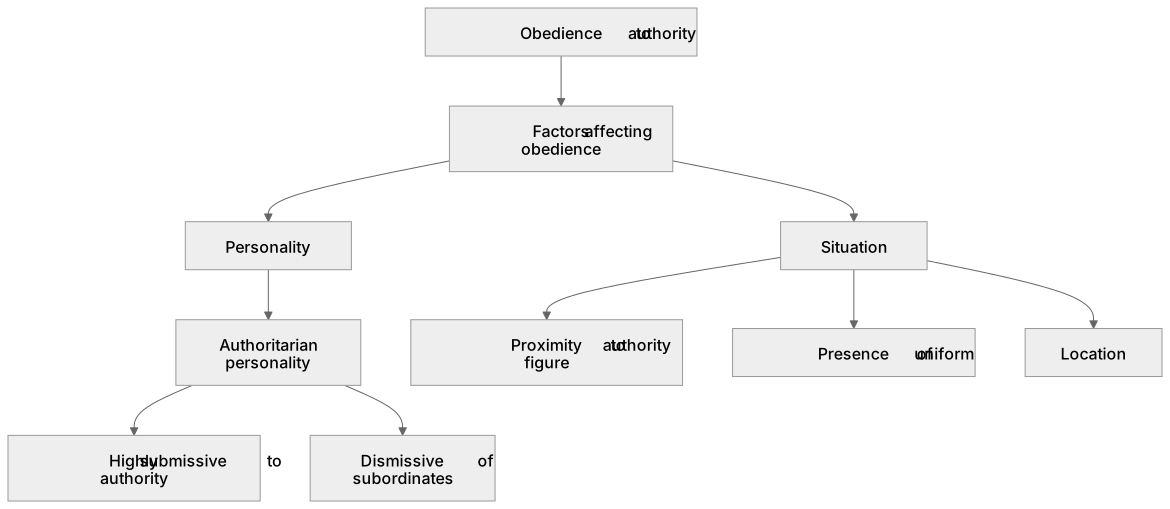
Obedience to authority involves following direct commands, typically from someone perceived as having legitimate power or higher status. Factors affecting obedience include both personality and the situation. Personality factors include the authoritarian personality, where individuals are highly submissive to authority and dismissive of subordinates, making them more likely to obey. Situational factors involve the environment or context, such as proximity to the authority figure, the presence of uniform, and the location.
For example: A person is more likely to obey a police officer in uniform giving instructions at a busy intersection than a civilian giving the same instructions, due to the situational cues of legitimate authority.
What earns the marks
- Define obedience as following direct orders from a perceived authority figure.
- Identify the authoritarian personality as a dispositional factor increasing obedience.
- Explain how individuals with an authoritarian personality respect authority and are more likely to obey commands.
- Identify situational factors affecting obedience, such as proximity, location, and uniform.
- Explain how the presence of a uniform or a prestigious location increases the perceived legitimacy of the authority, thereby increasing obedience.
Common mistakes and how to put them right
Confusing obedience with conformity.
Put it right: Obedience involves direct orders from an authority, while conformity is peer pressure without direct commands.
Ignoring the role of the situation; students often focus solely on personality, but situational factors like proximity to the authority figure are crucial.
Misunderstanding the authoritarian personality.
Put it right: It is not just about being bossy, but specifically involves extreme respect for authority and contempt for those perceived as inferior.
Exam tips
- Clearly differentiate between dispositional (personality) and situational explanations for obedience in your answers.
- Use concrete examples of situational factors, such as the impact of wearing a uniform, to demonstrate your understanding of legitimate authority.
- When discussing personality, explicitly mention the authoritarian personality and its characteristics to secure specific marks.
Try the lesson
The start of the Social influence: 5.1.4 Understand obedience to authority and factors affecting obedience to authority figures, including: a. personality b. the situation lesson, made from checked teaching notes for this specification point.
Have a go first
Which of the following is a situational factor that can increase a person's obedience to an authority figure?
Listen
Obedience to authority involves following direct commands, typically from someone perceived as having legitimate power or higher status. Factors affecting obedience include both personality and the situation. Personality factors include the authoritarian personality, where individuals are highly submissive to authority and dismissive of subordinates, making them more likely to obey. Situational factors involve the environment or context, such as proximity to the authority figure, the presence of uniform, and the location. For example, a person is more likely to obey a police officer in uniform giving instructions at a busy intersection than a civilian giving the same instructions, due to the situational cues of legitimate authority. A strong answer earns marks for these points. Define obedience as following direct orders from a perceived authority figure. Identify the authoritarian personality as a dispositional factor increasing obedience. Explain how individuals with an authoritarian personality respect authority and are more likely to obey commands. Identify situational factors affecting obedience, such as proximity, location, and uniform. Exam tip: Clearly differentiate between dispositional (personality) and situational explanations for obedience in your answers.
See it
Key words
Say what each word means before you turn the card.
Obedience
Try answering aloud or in your head before turning the card.
Authoritarian personality
Try answering aloud or in your head before turning the card.
Situational factors
Try answering aloud or in your head before turning the card.
See every definition
- Obedience
- Following direct commands, typically from someone perceived as having legitimate power or higher status.
- Authoritarian personality
- A personality where individuals are highly submissive to authority and dismissive of subordinates, making them more likely to obey.
- Situational factors
- Factors that involve the environment or context, such as proximity to the authority figure, the presence of uniform, and the location.
Label the diagram
Some boxes have lost their names. Pick the right name for each number.
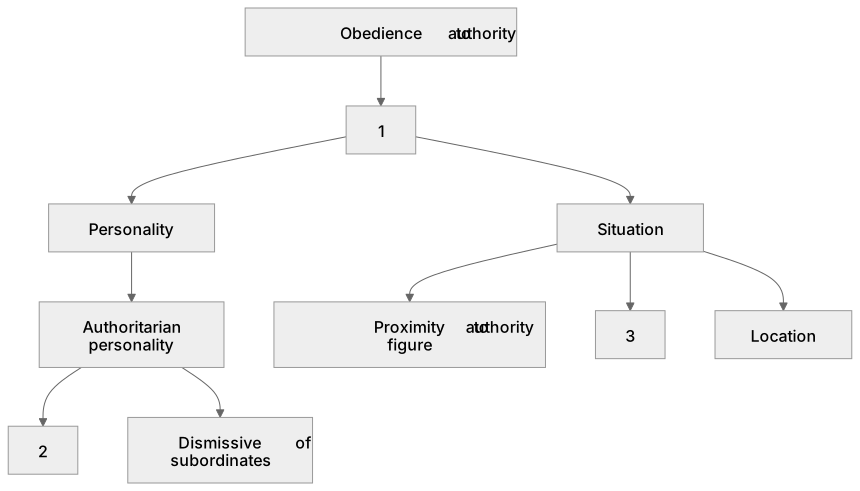
1Box 1
2Box 2
3Box 3
There is more to this lesson
The full lesson goes on to check your understanding and help you earn the marks. Create a free account to carry on, with your progress saved.
A week of Premium from your first lesson · Then the free plan continues · No card, no charge
Test your understanding of Social influence: 5.1.4 Understand obedience to authority and factors affecting obedience to authority figures, including: a. personality b. the situation
Active recall beats re-reading. Take an instant quiz now to test what you’ve learned and lock it into long-term memory.
A week of Premium from your first lesson · Then the free plan continues · No card, no charge